Dodeca Copilot Connector
Overview
The Copilot connector is a modular extension that allows Dodeca to leverage Copilot models to analyze and interpret structured reports and data. It also supports MCP (Model Context Protocol) tool sources, enabling models to call external tools and services during a conversation.
Once imported, it enables AI-assisted insights, summarization, and data interpretation directly within the application and views.
Prerequisites
Before configuring the Dodeca Copilot Connector, the following prerequisites must be completed:
-
A new client application must be registered on the Microsoft Identity Platform.
-
To consume
Microsoft 365 Copilot, the client application must be granted the following Microsoft Graph Permissions. -
To consume
Copilot Studioagents, the client application must be granted the following Power Platform API Permissions.
Getting Started
First, import the Copilot Connector module into your Dodeca tenant and create a Copilot connection that uses a configured Microsoft Authorization connection. After verifying connectivity by testing the connection, the connector can be associated with an AI Chat Component and added to a Dodeca view. Once configured, users can interact with Copilot directly within Dodeca to analyze data, generate summaries, and gain insights from reports and dashboards.
ℹ️ Note: Supported in Dodeca 8.7.0 and higher, the AI Chat Component module provides a familiar, assistant-ui-based chat component.
Copilot Connection Properties
Connection Properties
Required properties to establish a connection to the Copilot platform:
| Property | Requirement | Description |
|---|---|---|
OAuthConnectionID |
Required |
The Microsoft Authorization Connection for the Copilot platform. |
Test Properties
The following properties can be set to execute a prompt and generate a response during testing:
| Property | Requirement | Description |
|---|---|---|
Prompt |
Optional |
The prompt to send to the Copilot platform. |
Tool Sources |
Optional |
MCP server connections that provide tools to the chosen model. |
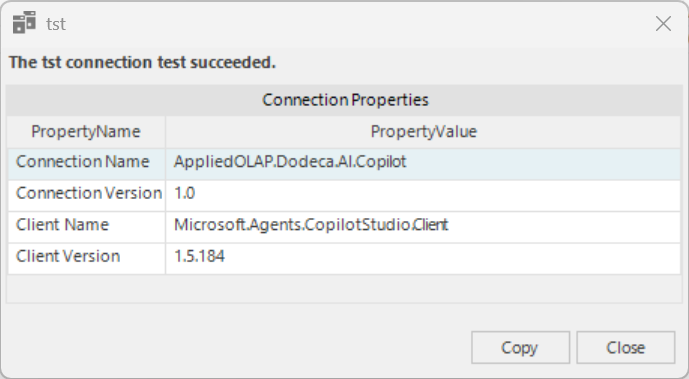
The following success message will be displayed if the connection is successful.
Using the Copilot Connector
The SAMPLE metadata from Applied OLAP is used in the following example. To add support for and configure the Copilot Connector, a Dodeca administrator can follow these steps:
-
Download and import the latest version of the Copilot Connector and the AI Chat Component modules into a Dodeca tenant.
-
Restart the Dodeca application. The
Copilot Connectorand theAI Chat Componentare now available for use. -
Create and configure a Copilot connection using the properties above, then test the connection before proceeding.
-
Go to the
Viewseditor and select an existing Dodeca view you would like to enhance with AI capabilities. -
In the
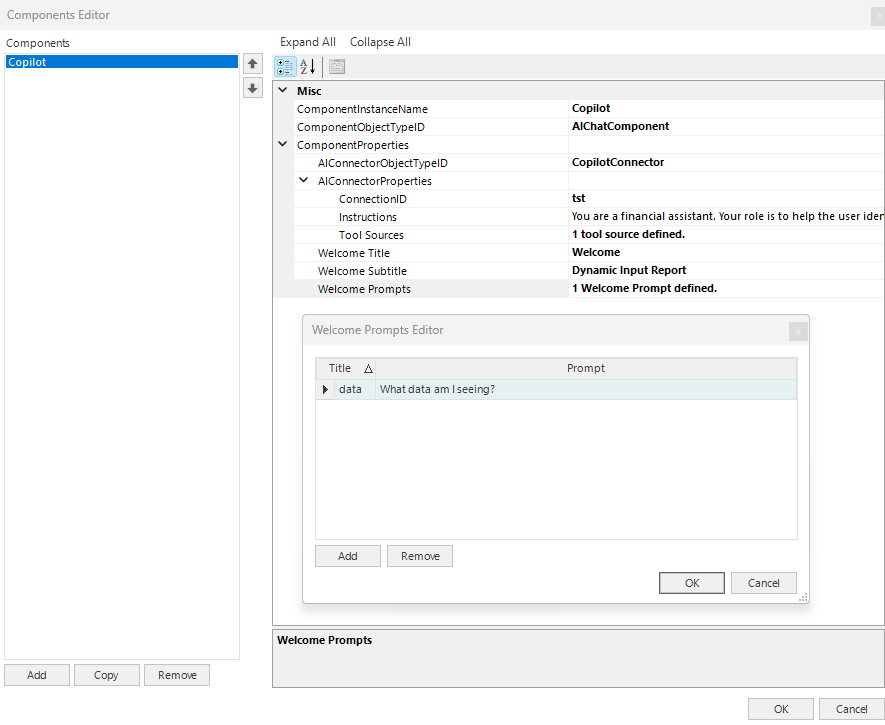
Viewproperties grid, find theComponentscategory and press the ellipsis button of theComponentsproperty to add a new component.A new
AI Chat Componentcan be added and configured via the following properties:Property Requirement Description ComponentInstanceName
Required
The name by which to identify the new component.
ComponentObjectTypeID
Required
The component type to use:
AIChatComponent.AIConnectorObjectTypeID
Required
The AI connector type to use:
CopilotConnector.ConnectionID
Required
The Copilot connection to use.
Instructions
Optional
An instruction set with which to prime the chosen model. These instructions can be modified to fit your needs.
Tool Sources
Optional
Copilot agent connections that provide tools consumable by the AI connection.
Welcome Title
Optional
A welcome message to display in the chat component when first loaded.
Welcome Subtitle
Optional
A welcome subtitle to display in the chat component when first loaded.
Welcome Prompts
Optional
A set of prompts to display as buttons in the chat component when first loaded. These can be used to guide users on how to interact with the component.
-
Press OK to keep the new component configuration. The
AI Chat Componentis now added to your view and ready to test. -
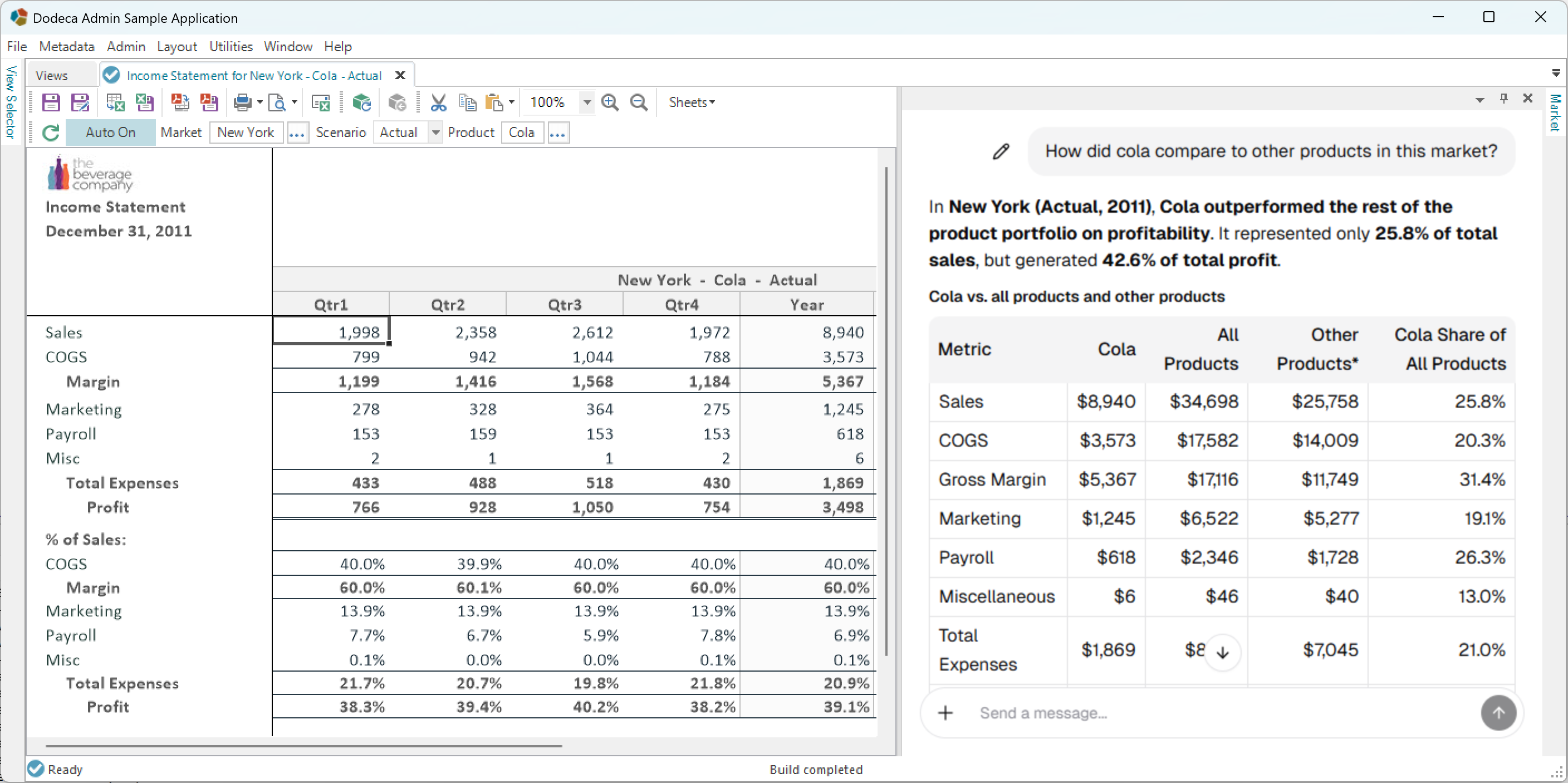
Press Preview to test and interact with the new component.
-
Return to the
Viewseditor and pressCommit Selectedto save the changes.
Release History
Version 1.1
-
Add support for sessions and multi-turn conversation interaction.
-
Add
Effort,Instructions, andTool Sourcesproperties.
Version 1.0
-
Initial release. Includes support for generating content via the workbook script AIOperations method.